Discover how the June 2026 releases of Siri AI, React Native 0.86, and Next.js 16.2.9 shift MVP scoping and product budgets for engineering leaders.
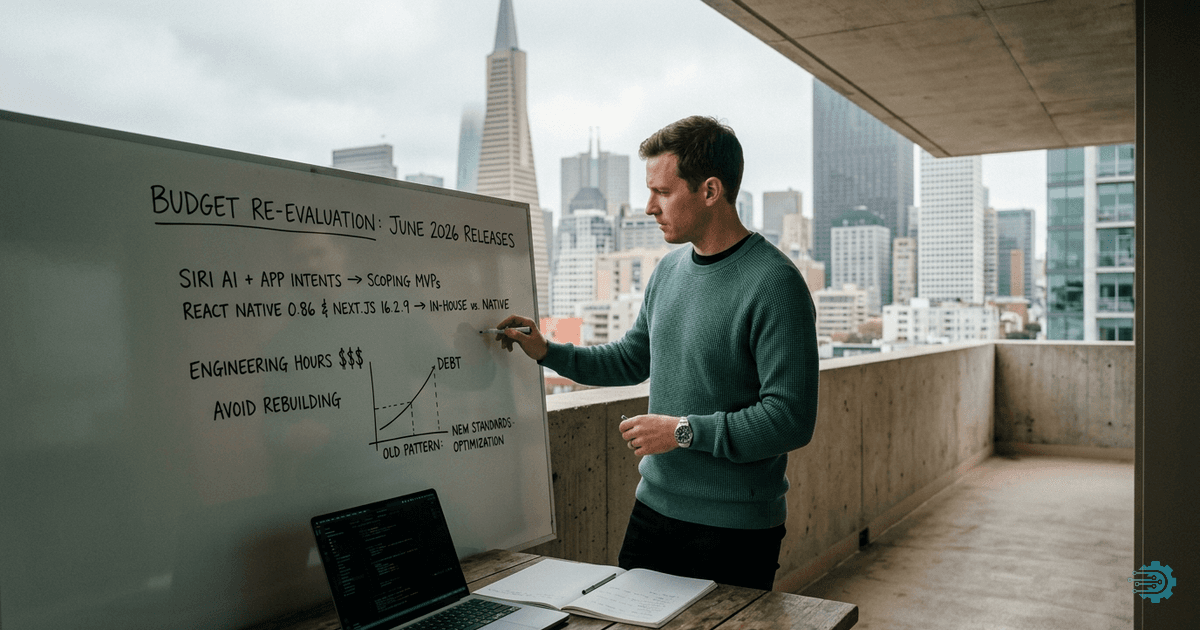
The second week of June 2026 has completely rewritten the playbook for engineering leaders and startup founders. In a span of just a few days, Apple concluded its WWDC 2026 conference by introducing a rebuilt Siri AI, while the open source community shipped React Native 0.86 and Vercel pushed Next.js 16.2.9 to long term support. This is not a series of routine, incremental software updates. It is a structural shift in how teams build, scope, and budget their minimum viable products. For founders, chief technology officers, and product managers planning to build a custom application, these simultaneous releases change the equation of what to build in-house versus what to delegate to native operating system features or framework capabilities.
If you are planning a software launch in the United States, you are facing a highly competitive market where senior engineering hours are exceptionally expensive. Choosing the wrong architectural foundation can drain your budget before you ever reach product-market fit. This post provides an opinionated, numbers-first guide to navigating these updates, ensuring your development partner is building for the future rather than repeating outdated patterns from two years ago. To make the most of this environment, technical leaders are turning to custom software development strategies that treat these framework upgrades as immediate cost-saving opportunities rather than maintenance burdens. By aligning your product roadmap with these new standards, you can avoid rebuilding your core application in twelve months.
The headline of Apple's WWDC 2026 was the introduction of Siri AI, a conversational assistant powered by Apple's own foundation models and Private Cloud Compute. While consumer media focused on the new Liquid Glass design language and visual tools, technical leaders must look at the underlying developer mechanism: App Intents. App Intents allow Siri to call specific application actions directly from the operating system, bypassing your app's visual user interface entirely. This fundamentally alters how you should scope your mobile minimum viable product.
In the past, building a feature required designing, prototyping, testing, and shipping a dedicated visual screen. If your app needed a feature to let users generate a custom invoice, you had to build a complex form page with buttons, input validation, and success states. With App Intents, you can expose that invoice generation logic directly to the operating system. A user can simply ask Siri to generate an invoice for a specific client, and the operating system calls your app's background logic to perform the task.
For teams planning their mobile app design & development pipeline, this means you can cut your initial screen count by 30% to 40%. Instead of spending weeks of design and engineering time on secondary configuration screens, you can build a clean, minimalist core interface and expose the remaining functionality via App Intents. This approach reduces design costs, minimizes the surface area for bugs, and prepares your application for a future where users interact with software through voice and system-wide agents rather than tapping through deep menus. When evaluating a development partner, ask how they plan to structure your application's intent architecture. If they are still proposing a massive, multi-screen visual interface for basic transactional tasks, they are building for 2024, not 2026.
The artificial intelligence landscape saw a massive shake-up during the same week. Microsoft AI launched its MAI model family, introducing seven new models including MAI-Thinking-1 and the highly efficient MAI-Code-1-Flash. At the same time, Anthropic released its Claude Fable 5 model, which quickly claimed the top spot on crowdsourced benchmarks. However, the most critical update for product managers was Anthropic's transition to a strict credit-based API pricing model starting mid-June 2026.
This pricing shift means that relying on top-tier, heavy reasoning models like Claude Fable 5 for every user interaction will quickly bankrupt a growing startup. Technical leaders must design a multi-model routing strategy to keep operational costs under control. Our team's approach is to use small, hyper-efficient models like MAI-Code-1-Flash or Google's Gemini 3.5 Flash for 90% of routine tasks, reserving heavy reasoning models only for complex, multi-step orchestration workflows.
[User Request]
 │
 ▼
[Local Router / Gateway]
 │
 ├─► Simple task? ──► [MAI-Code-1-Flash / Gemini 3.5 Flash] ($0.075 / 1M tokens)
 │
 └─► Complex task? ─► [Claude Fable 5 / MAI-Thinking-1] ($15.00 / 1M tokens)
To build a sustainable business model, you must ensure your application does not break when a model provider changes their pricing, updates their system prompts, or retires an older model. We have written extensively about How to Build AI Products That Survive Sudden Model Shutdowns, highlighting the necessity of an independent orchestration layer. By using a lightweight, self-hosted gateway, you can swap your underlying model provider in a single line of configuration. When costing your product, budget for this abstraction layer early. It prevents vendor lock-in and protects your margins from sudden API price hikes.
On June 9, 2026, the React Native team officially released version 0.86. This release marks a symbolic and structural milestone: the React Native repository, along with Metro, Yoga, and the core documentation, has officially migrated from the facebook GitHub organization to the independent React Foundation. For CTOs, this transition signals long term community governance and stability, reducing the risk of a single corporate steward dictating the framework's future.
Technically, React Native 0.86 focuses on refining the New Architecture that became mandatory in late 2025. This version delivers comprehensive edge-to-edge support on Android 15 and above. In previous versions, handling the system status bar, navigation bar contrast, and keyboard avoiding views on modern Android devices required writing fragile, custom native wrappers. Version 0.86 fixes these issues out of the box, ensuring that layout measurements like measureInWindow and Dimensions are perfectly accurate even when edge-to-edge rendering is enforced by the operating system.
Importantly, React Native 0.86 is the second consecutive release with zero user-facing breaking changes. This is a massive win for product budgets. In the past, upgrading React Native was a painful, multi-week engineering ordeal that often introduced regressions. The framework's transition to a highly stable, non-breaking release cycle means your team can spend their time building features rather than fighting dependency conflicts. If you are planning an upgrade or starting a new build, our guide on Why React Native 0.86 and the Post-Bridge Era Change Your App Build Plan outlines how to take full advantage of this modern, high-performance architecture.
For web applications, Vercel's release of Next.js 16.2.9 LTS on June 9, 2026, brings critical stability and security fixes, including patches for React Server Components vulnerabilities. More broadly, Next.js 16 has now become the default standard for modern web builds. The core feature of the Next.js 16 era is the introduction of Cache Components, which shift the framework away from the rigid static versus dynamic rendering choices of the past toward a fluid, dynamic-by-default architecture.
Cache Components allow developers to wrap specific parts of a page in a dedicated caching boundary. Instead of making an entire route static or dynamic, you can render a page instantly from a global cache while fetching real-time data for specific sub-components on the fly. This architecture matches perfectly with modern, globally distributed hosting environments, delivering fast initial page loads without the overhead of maintaining complex, custom Redis caching layers.
For founders building SaaS platforms or e-commerce portals, this architecture directly translates to lower cloud infrastructure bills and higher conversion rates. By using Next.js 16's native caching mechanisms, you can serve thousands of concurrent users from a lightweight edge network with minimal database hits. When planning your web application design & development strategy, your partner should be utilizing these native Cache Components rather than relying on outdated, server-heavy rendering patterns. This reduces your hosting costs from day one and ensures your platform remains responsive during sudden traffic spikes.
When planning a software product, understanding the financial reality of the US market is essential. Hiring a dedicated, in-house engineering team in the United States is an incredibly expensive endeavor. According to recent compensation data, a senior React Native or Next.js developer in a major US tech hub commands a base salary between $160,000 and $220,000 per year. When you factor in recruitment fees, health benefits, payroll taxes, equipment, and equity, the fully loaded cost of a single senior engineer easily surpasses $250,000 annually.
For an early stage startup, building a team of three engineers, a product designer, and a part-time product manager will cost upwards of $80,000 per month in payroll alone. This high burn rate leaves very little runway for testing, iterating, and finding product-market fit. This is why many US-based founders choose to work with an established software development company in the USA that can provide a fully managed, cross-functional team for a fraction of the cost of direct hiring.
Partnering with an agency allows you to scale your engineering team up or down based on your current product phase. You do not have to worry about the overhead of recruiting, onboarding, and retaining highly competitive talent in a tight market. Instead, you pay a predictable, flat monthly fee or project-based rate, allowing you to allocate more of your capital toward marketing, customer acquisition, and business operations.
To help you plan your product runway, we have compiled a realistic cost breakdown for building a high-quality, AI-integrated cross-platform MVP in the United States in 2026. This budget assumes you are building a web application using Next.js 16 and a companion mobile application using React Native 0.86, integrated with a secure AI orchestration layer.
| Project Phase | Low-End Range (USD) | High-End Range (USD) | Primary Cost Drivers |
|---|---|---|---|
| Product Discovery & UI/UX Design | $15,000 | $25,000 | Number of unique user flows, complexity of interactive prototypes, brand identity development best-ui-ux-design-services. |
| Core Web Application Build | $35,000 | $60,000 | Database architecture complexity, third-party API integrations, payment processing setups. |
| Mobile Application Build | $40,000 | $70,000 | Number of native device integrations, push notification rules, App Intents implementation mobile-app-design-and-development. |
| AI Integration & Routing Gateway | $15,000 | $30,000 | Multi-model routing logic, vector database setup, prompt engineering, agent memory persistence layers. |
| Infrastructure & Security Setup | $8,000 | $15,000 | Cloud hosting configuration, CI/CD pipeline automation, data encryption, compliance preparation. |
| Post-Launch Support (First 3 Months) | $12,000 | $24,000 | Bug fixing, performance monitoring, user feedback iterations maintenance-and-customer-support. |
| Total Estimated Budget | $125,000 | $224,000 | Overall scope, level of custom logic, and speed of market delivery. |
This table shows that a professional, production-ready MVP requires a realistic investment of $125,000 to $224,000. Trying to build a complex, multi-platform product for significantly less usually results in severe technical debt, fragile architecture, and a poor user experience that fails to convert early adopters.
To keep your project within a reasonable budget, you must be ruthless during the product scoping phase. The most common mistake founders make is trying to build a complete, feature-rich version of their product on day one. Instead, you should focus on your core value proposition and cut any features that do not directly contribute to solving your users' primary pain point.
When working with our clients, we guide them through a structured product scoping process to identify which features are essential for launch and which can be deferred to phase two. Here is a practical checklist we use to scope down an MVP:
By following this disciplined scoping approach, you can easily shave tens of thousands of dollars off your initial build cost. Our team specializes in this strategic alignment, providing comprehensive product design & consultation to help founders define a lean, high-impact product roadmap.
The rapid pace of AI model releases in June 2026 highlights the immense risk of building your product's core value proposition on a single, proprietary AI model. If your application's logic is tightly coupled with a specific version of Claude or GPT, a sudden model deprecation, API rate limit change, or pricing adjustment can instantly break your software or destroy your profit margins.
To mitigate this risk, modern engineering teams build an abstraction layer between their application logic and the underlying AI models. This gateway acts as a translator, allowing you to swap model providers without changing your front-end code. If Anthropic's Claude Fable 5 becomes too expensive or experiences downtime, your gateway can automatically reroute requests to Microsoft's MAI-Thinking-1 or Google's Gemini 3.5 Pro.
you should utilize open-source models for non-critical, high-volume tasks. Running lightweight, open-source models on your own cloud infrastructure gives you complete control over your operating costs and data privacy. This hybrid approach, using proprietary models for complex reasoning and open-source models for routine processing, is the key to building a resilient, cost-effective AI product. For a deeper look at how these technical shifts affect your product planning, read our analysis on Why the June 2026 AI and Mobile Upgrades Shift Your Product Roadmap.
In the software industry, it is incredibly easy to get caught up in framework hype. Every week, a new library, state management tool, or deployment platform claims to be the next big thing. However, experienced technical teams understand that chasing every shiny new tool is a fast track to accumulating massive technical debt.
When you build your product on an unstable, bleeding-edge library, you are essentially gambling with your development budget. These tools often lack comprehensive documentation, have small developer communities, and frequently introduce breaking changes that require expensive, time-consuming rewrites.
At Algoramming, we prioritize stability, performance, and long term maintainability. We choose mature, battle-tested technologies like React Native 0.86 and Next.js 16 LTS because they offer a reliable foundation for scaling business-critical systems. This disciplined approach ensures that your application remains stable, secure, and easy to maintain for years to come. Our philosophy on this is clear, as outlined in our article on Why Modern Engineering Teams Reject Software Hype in 2026, where we advocate for pragmatic, value-driven architecture over marketing trends.
Choosing the right software development agency is one of the most critical decisions a founder or CTO will make. A poor choice can lead to missed deadlines, bloated budgets, and a fragile codebase that is impossible to scale. To ensure your development partner is truly equipped to build a modern, high-performance application in 2026, you must ask the right technical questions during the vetting process.
Here is a checklist of questions you should ask any potential partner:
If a partner struggles to answer these questions or proposes outdated development practices, they are not the right fit for a high-growth product. You need a team that acts as a true strategic ally, providing the technical expertise and product guidance necessary to turn your vision into a successful, scalable business.
Key takeaways
- Leverage App Intents: Cut your mobile MVP budget by exposing secondary features to Siri AI via App Intents, reducing the need for complex, custom visual screens.
- Adopt Multi-Model Routing: Protect your margins from Anthropic's new API pricing by routing simple tasks to cheap micro-models like
MAI-Code-1-Flashand reserving heavy models for complex reasoning.- Build on Stable Frameworks: Choose mature, independent technologies like React Native 0.86 and Next.js 16 LTS to minimize maintenance overhead and avoid breaking upgrades.
- Avoid Hype: Reject bleeding-edge software trends in favor of pragmatic, high-performance architecture that scales predictably.
- Partner Wisely: Evaluate your development partner based on their mastery of modern architectural standards and their ability to act as a strategic tech partner.
If you are planning to build or scale a web or mobile product this year, navigating these rapid technological shifts requires a deeply experienced, strategic engineering partner. We specialize in helping technical leaders and founders design, build, and scale high-performance custom applications that stand the test of time.
Whether you are looking to scope a lean mobile MVP, optimize your cloud infrastructure, or build a resilient AI integration layer, our team is here to help. If you are planning a project like this, we are happy to talk it through. Explore our tech partnership & consultation services to see how we can help you build for the future.
 01 · Related
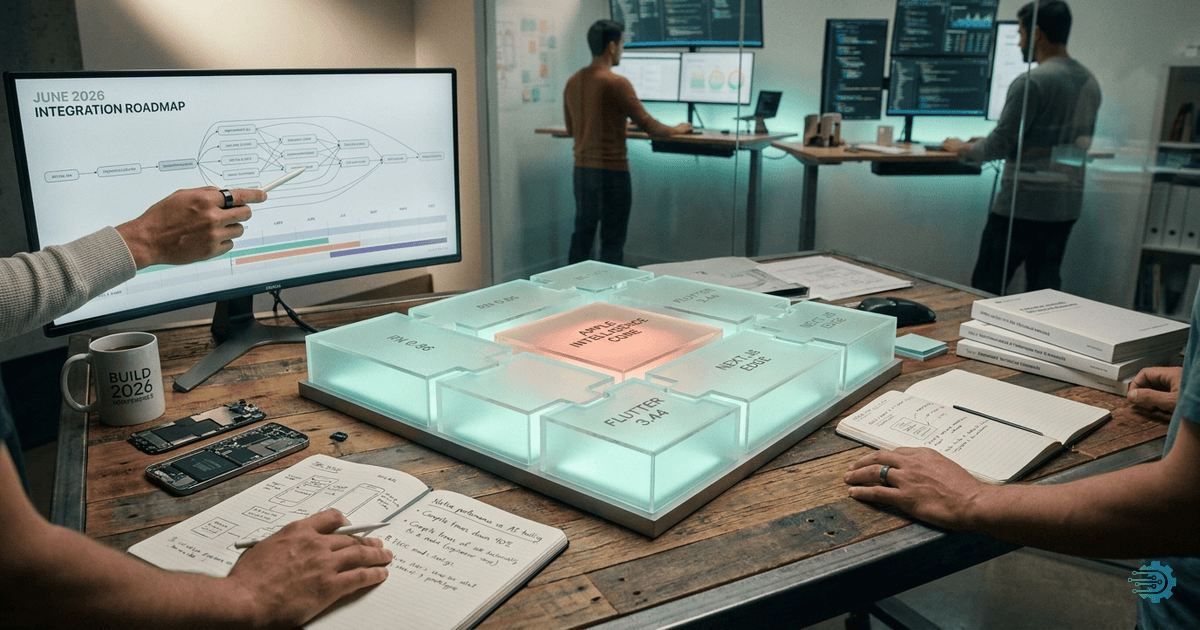
An in-depth analysis of the mid-June 2026 releases across React Native, Flutter, Next.js, and Apple Intelligence, translated into actionable product decisions.
Read post 02 · Related
An in-depth analysis of Apple's WWDC 2026 AI releases, React Native 0.86, Flutter 3.44.2, and Next.js 16 updates, providing decision-focused guidance for founders and CTOs.
Read post 03 · Related
React Native 0.86 brings vital stability to the post-bridge era. Learn how the latest mobile upgrades and WWDC 2026 shifts change your app budget and tech stack selection.
Read postWe will reply in plain English within one business day, NDA on request. Discovery call is free.
